
How to Map Finance Workflows That Scale
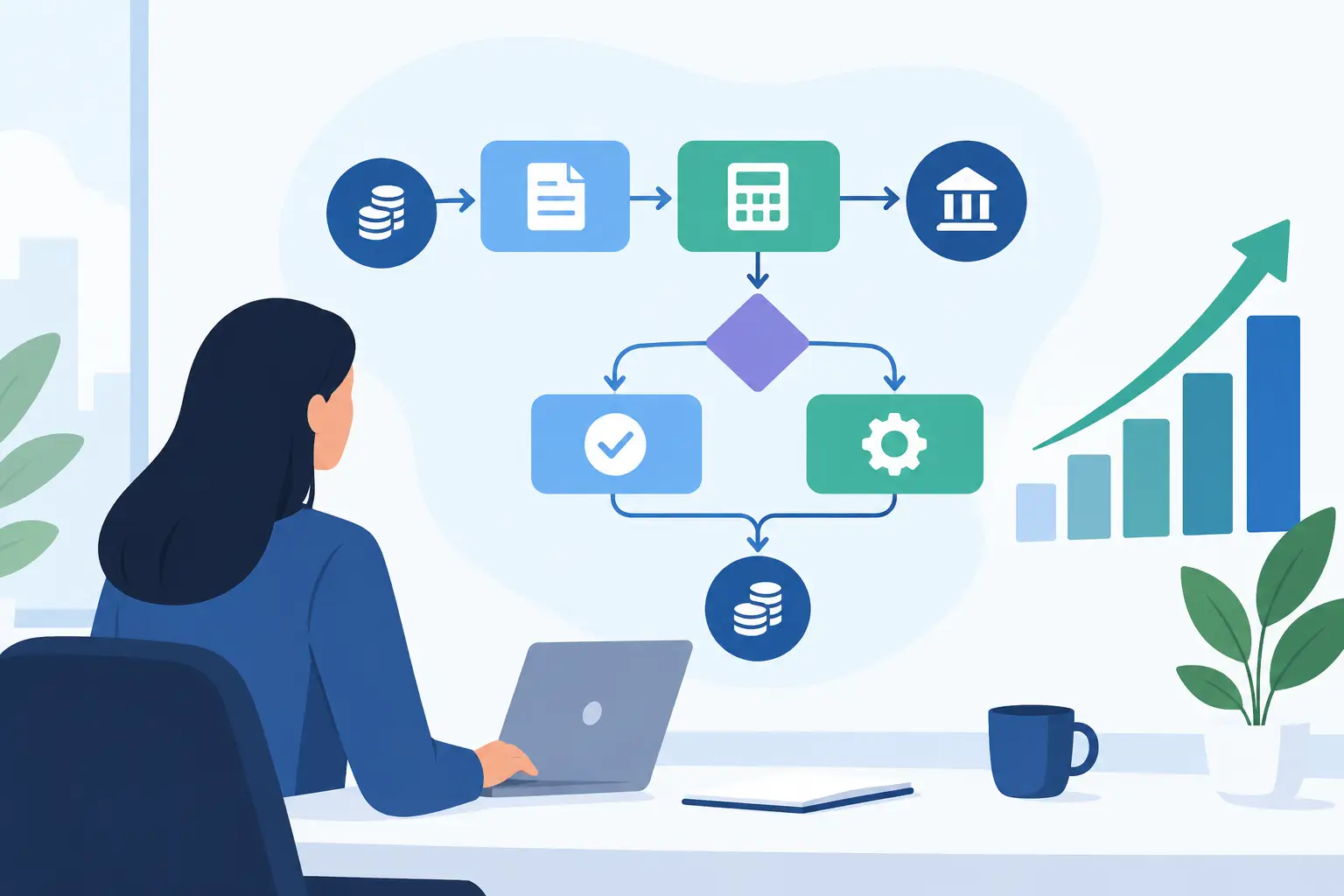
Month-end closes in nine business days, but no one can clearly explain where the time goes. Forecast updates require multiple spreadsheet versions and late-night reconciliations. Leaders receive reports, yet still question whether the numbers are current. These are not isolated accounting problems. They are process-design problems, and knowing how to map finance workflows is the first step toward resolving them.
A finance workflow map turns informal habits, disconnected systems, and unclear handoffs into an operating view of how work actually gets completed. For CFOs, CEOs, and private equity-backed management teams, that visibility is essential. It reveals where financial information slows down, where risk concentrates, and where a targeted change can improve decision-making without creating unnecessary disruption.
Why Finance Workflow Mapping Matters
Finance functions often evolve faster than their processes. A growth-stage company may add entities, customers, products, systems, and reporting requirements while relying on procedures built for a much smaller organization. Workarounds can keep the team moving for a time, but they eventually create rework, control gaps, and a dependence on individual institutional knowledge.
Workflow mapping gives leadership a factual starting point. Rather than asking why the close is late or why forecasts change after review, the organization can trace the sequence: what triggers the work, who performs each activity, which data or system is used, what review occurs, and what must happen next.
The objective is not to document every keystroke. It is to identify the decisions, dependencies, handoffs, and controls that determine speed, accuracy, and accountability. A useful map supports practical questions: Can the close be shortened? Is a manual report worth automating? Does the forecast use governed data? Is the finance team reviewing transactions that a system rule could flag instead?
Start With a Business-Critical Workflow
Trying to map every finance activity at once usually produces a documentation project with limited operational value. Begin with a process that directly affects management visibility, cash, compliance, or the ability to scale.
For many organizations, the best starting point is the record-to-report process, including the month-end close and management reporting. Other high-value candidates include budget-to-forecast, procure-to-pay, order-to-cash, cash forecasting, or the annual planning cycle. The right choice depends on the business issue leadership needs to solve.
For example, a company preparing for a lender review may prioritize reporting and close controls. A rapidly growing business with recurring cash pressure may start with invoice-to-cash and short-term cash forecasting. A private equity-backed company focused on margin expansion may map the planning and KPI reporting workflows first.
Define the outcome before documenting the process
Set a clear scope statement that ties the map to a business result. “Document the close process” is too broad. “Reduce the close from nine to six business days while improving balance sheet review ownership” gives the team a decision standard.
Define the beginning and end of the workflow as well. A monthly close may begin when the accounting period ends, or earlier when recurring entries and subledger cutoffs begin. It may end when financial statements are issued, when management reporting is distributed, or when executive review actions are complete. The boundary should match the outcome you want to improve.
How to Map Finance Workflows Step by Step
Effective mapping combines evidence from the people doing the work with a clear process structure. Finance leaders should sponsor the effort, but the map must reflect operational reality, not an idealized policy document.
1. Gather the right people and evidence
Include process owners, preparers, reviewers, and adjacent teams that create or consume key inputs. For a close process, that may include accounting, FP&A, payroll, revenue operations, procurement, IT, and business unit leaders. A controller may understand the formal process, but the staff accountant who resolves late data feeds will often reveal the actual constraint.
Bring existing artifacts into the discussion: close checklists, report calendars, templates, policy documents, approval matrices, system screenshots, and recurring email requests. These materials help validate the workflow, but interviews and observation are still necessary. The goal is to understand what happens in practice, including the exceptions.
2. Map the current state, not the intended state
Build the workflow in chronological order. For each step, capture the trigger, activity, owner, system or data source, output, reviewer, timing, and next handoff. A swimlane format is often effective because it shows whether delays occur within a role, between functions, or at a system boundary.
Use plain language. “Revenue operations validates CRM contract changes and sends the approved file to accounting” is more useful than “revenue data processing.” The first statement can be tested for timing, ownership, and control. The second cannot.
Do not omit manual work simply because it is inconvenient to describe. Spreadsheet consolidations, emailed approvals, journal entry support prepared outside the ERP, and verbal escalation paths are often where risk and delay live.
3. Identify decision points, controls, and exceptions
A linear map alone is not enough. Finance processes are defined by the moments when someone decides whether information is complete, whether an adjustment is appropriate, or whether an exception needs escalation.
Mark approval points and key controls directly in the map. Distinguish between controls that genuinely mitigate risk and steps that persist only because “that is how we have always done it.” Multiple reviews may be appropriate for a material journal entry or a payment release. They are less defensible when they add days to a routine, low-risk report with no meaningful challenge or change.
Also document what happens when the process does not go as planned. If inventory data arrives late, who is notified? If a forecast assumption changes after executive review, is there a formal version-control process? Exception paths frequently expose unclear accountability more quickly than the standard workflow.
4. Measure delay, rework, and effort
Once the steps are visible, add operational data. Measure elapsed time, touch time, error rates, number of handoffs, late inputs, and rework cycles. A task that takes 20 minutes of effort but waits two days for an upstream file is not a productivity issue. It is a dependency issue.
This distinction matters when setting improvement priorities. Automation may reduce touch time, but it will not fix a late approval from a commercial team. Similarly, a new planning platform may improve consolidation, but it cannot resolve conflicting KPI definitions across business units.
5. Design a future state with disciplined trade-offs
The future-state map should simplify the process while preserving the level of control the business needs. That may mean eliminating duplicate reconciliations, standardizing a data source, moving a review earlier in the cycle, establishing clear service-level expectations, or automating a repetitive data transfer.
Avoid treating automation as the default answer. A poorly designed workflow automated at scale can make errors move faster. First clarify the process, ownership, and decision rules. Then determine whether system configuration, integration, workflow tools, or a redesigned operating cadence will create the strongest return.
What a Useful Finance Workflow Map Includes
A map should be detailed enough for a new team member to understand how work moves, yet concise enough for an executive to see where intervention is needed. At minimum, it should show:
- The trigger and intended output for the process
- Activities in sequence, including manual work and system actions
- The accountable owner, preparer, reviewer, and downstream recipient
- Core systems, reports, data sources, and file transfers
- Approval points, control activities, and escalation paths
- Cycle time, recurring delays, and known failure points
For complex processes, maintain two views. An executive-level view highlights the major stages, risks, and improvement decisions. A working-level map captures detailed steps, inputs, and operating procedures. Combining both into one artifact usually makes it too vague for operators and too dense for leadership.
Turn the Map Into an Improvement Plan
Mapping creates value only when it changes how the function operates. Translate findings into a prioritized plan with an owner, expected benefit, investment requirement, and implementation timeline.
Quick wins may include standardizing close checklists, assigning explicit report owners, eliminating duplicate data pulls, or establishing a forecast calendar. Larger initiatives might involve redesigning the chart of accounts, integrating systems, implementing a planning platform, or redefining management KPIs. Both matter, but they should not be managed with the same urgency or governance.
Prioritize initiatives by business impact and feasibility. A bottleneck that delays executive reporting every month may outrank a highly visible manual task that consumes little time. Likewise, a control weakness around cash disbursements deserves attention even if it does not materially affect cycle time.
Set baseline metrics before changing the process. Track close duration, forecast cycle time, on-time report delivery, number of manual journal entries, reconciliation aging, and forecast variance where relevant. These measures make progress visible and prevent the organization from declaring success based on anecdotal feedback.
Common Mapping Mistakes to Avoid
The most common mistake is mapping the policy rather than the work. If staff members maintain shadow spreadsheets, wait on informal approvals, or correct system outputs manually, those realities belong in the current-state map.
Another mistake is assigning ownership to a department rather than a person or role. “Finance” is not accountable. A controller, FP&A manager, accounting manager, or business operations lead can be. Clear ownership is particularly important at cross-functional handoffs, where issues otherwise remain unresolved.
Finally, do not let documentation become the finish line. A workflow map should be a management tool used in close retrospectives, planning-cycle reviews, system decisions, and operating meetings. If it is filed away after a workshop, it will not improve performance.
A well-mapped finance workflow gives leaders more than a cleaner process diagram. It creates a shared operating language for deciding what to fix, what to control, and what to scale next. That clarity is often the difference between a finance function that reports the past and one that helps the business manage its future.
Related Articles

12 Profitability Reporting Questions Leaders Need
The profitability reporting questions leaders should ask to reveal margin drivers, improve accountability, and make better growth decisions at scale now.

Annual Plan Versus Rolling Plan for Growth
Annual plan versus rolling plan: compare control, agility, resources, and forecast accuracy to choose the planning model that supports disciplined growth.

Cash Forecasting Versus Profit Forecasting for Growth
Cash forecasting versus profit forecasting reveals different risks. Learn how leaders use both to protect liquidity, margins, and growth at scale.